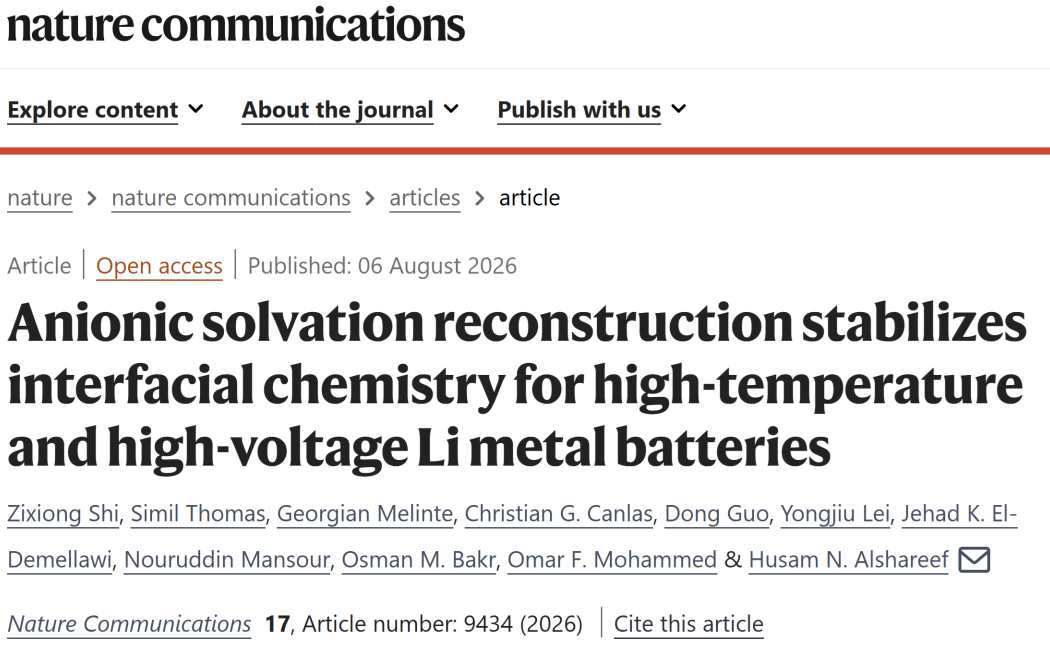
We are delighted to share our recent research published in Nature Communications, titled “Anionic solvation reconstruction stabilizes interfacial chemistry for high-temperature and high-voltage Li metal batteries.”
Led by Dr. Zixiong Shi under the supervision of Prof. Husam Alshareef, this study addresses a key challenge in developing high-energy lithium metal batteries: maintaining stable electrolyte chemistry and electrode interfaces under high-temperature and high-voltage operating conditions.
Using multimodal ¹⁹F nuclear magnetic resonance (NMR) techniques, the team investigated the temperature-dependent evolution of anionic solvation structures and their influence on electrolyte stability. Based on these findings, the researchers developed an anion-anchored compact solvation structure characterized by large, anion-compressed solvation clusters. This electrolyte design enhances oxidation resistance, stabilizes the electrode–electrolyte interphases, and helps preserve the structural integrity of positive electrodes under demanding operating conditions.
Importantly, the proposed electrolyte strategy was demonstrated in a lithium metal pouch cell with an energy density of 317 Wh kg⁻¹, achieving enhanced thermal safety and prolonged cycling performance at elevated temperatures.
This work provides new insights into the relationship between electrolyte solvation chemistry and interfacial stability, offering a promising strategy for developing safer and more reliable high-energy batteries capable of operating in challenging thermal environments.
Congratulations to Zixiong and all co-authors on this excellent publication!