We are delighted to share our research published in Advanced Science, entitled “MXenes Contacts for p-type 2D Electronics.”
Achieving efficient and low-resistance electrical contacts remains a fundamental challenge in the development of high-performance two-dimensional (2D) semiconductor devices, particularly for p-type electronics. With their rich compositional diversity and versatile surface terminations, MXenes offer a unique materials platform with tunable electronic structures, work functions, and interfacial properties, presenting exciting opportunities for contact engineering in 2D electronics.
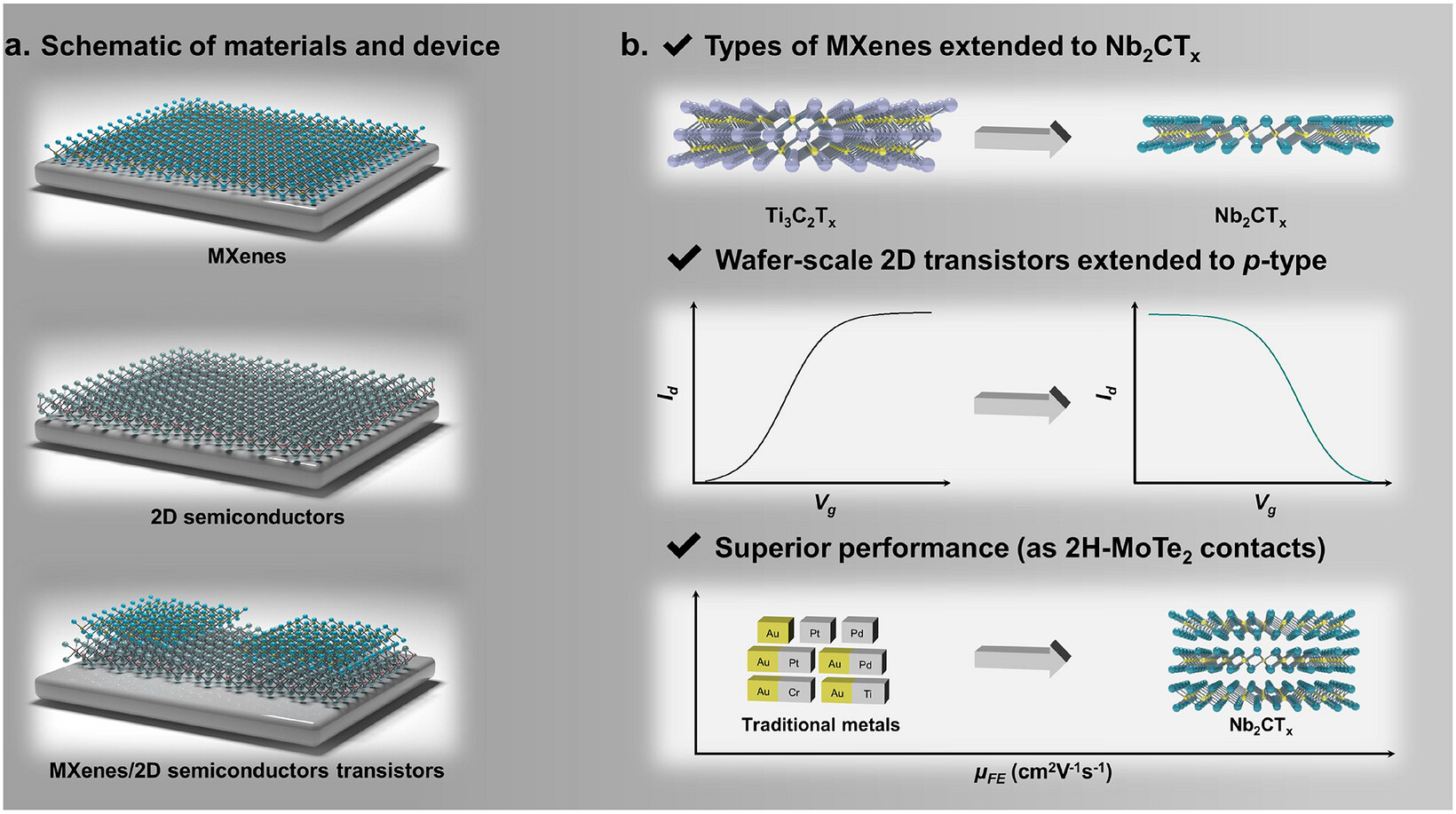
In this work, we systematically investigated three representative MXenes (Ti₃C₂Tₓ, Nb₂CTₓ, and Mo₂CTₓ) as contact electrodes for p-type 2H-MoTe₂ transistors, highlighting the critical role of MXene composition in interfacial charge transport.
By combining compositional engineering with a polymer-assisted transfer strategy, we demonstrated that Nb₂CTₓ provides favorable energy-level alignment with the semiconductor, facilitating efficient hole injection while minimizing interfacial damage and reducing contact resistance.
The resulting field-effect transistors exhibited a hole mobility of approximately 17 cm² V⁻¹ s⁻¹ and an on/off current ratio exceeding 10³. Temperature-dependent electrical measurements further revealed a remarkably low Schottky barrier of only a few millielectronvolts under strong gate bias.
Beyond demonstrating the effectiveness of Nb₂CTₓ as a contact electrode, this work underscores the largely untapped potential of the diverse MXene family in electronic devices. The vast chemical design space offered by different elemental compositions and surface terminations opens new opportunities for tailoring electronic properties, engineering semiconductor interfaces, and developing next-generation electronic devices.
Congratulations to Tianchao Guo and Maolin Chen, the co-first authors, and all collaborators on this achievement. We look forward to further exploring the rich chemistry of MXenes and expanding their applications in emerging electronic technologies.